
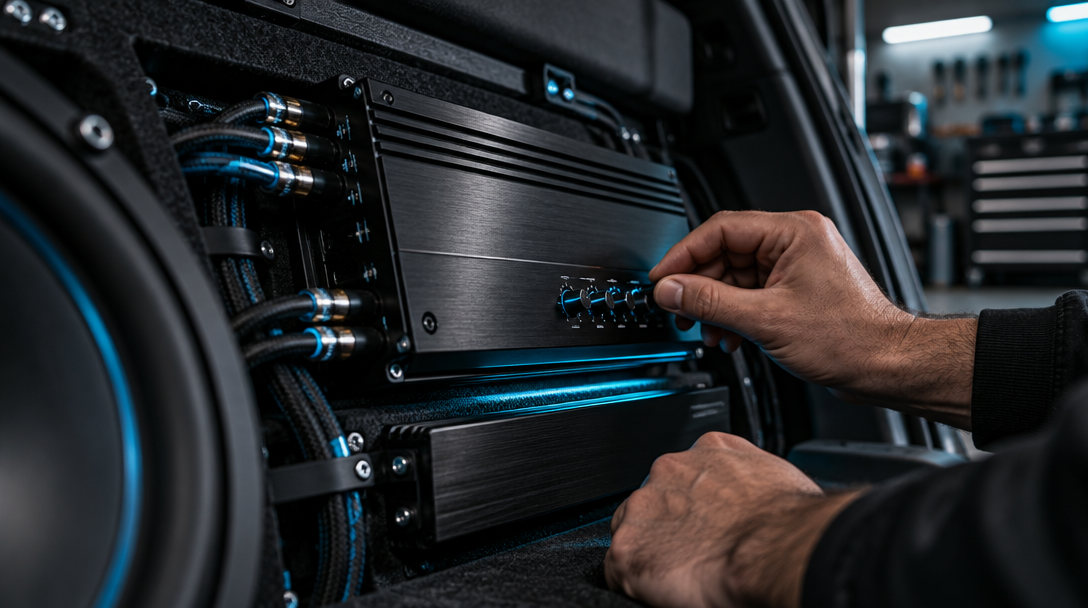
How to Tune Your Car Amplifier: Gain, Crossover and Bass Boost Settings Explained
A car amplifier can transform your system, but only when it’s set up correctly. Set the gain too high and you’ll distort the sound and risk damaging your speakers. Set the crossover wrong and your bass will sound boomy or your speakers will struggle. This guide explains the three settings that matter most, in plain English, so you know what a properly tuned system should sound like.
Before you start: check the basics
Tuning works best once the installation is sound. Make sure the power and earth connections are clean and tight, the fuse is within the correct distance of the battery, and the speakers are wired with the correct polarity. A fault in the wiring will show up as noise or dropouts no matter how carefully you set the amplifier.
Gain: match the amplifier to the head unit
Gain is the input sensitivity control on your amplifier. It matches the signal coming from the head unit to the amplifier’s input range. It is not a volume knob.
- Turn the gain fully down, and set the head unit volume to about three quarters of its maximum.
- Play a familiar track with a good dynamic range.
- Slowly turn the gain up until you hear the first sign of distortion, then back off slightly.
Many installers use a multimeter or oscilloscope for a precise setting. The goal is to use the full signal without clipping, which keeps the sound clean and protects your speakers.
Crossover: send the right frequencies to the right speakers
The crossover decides which frequencies each speaker plays. Getting it right improves clarity and stops your speakers from being asked to do work they can’t handle.
- High-pass filter for door speakers: Set this around 80 Hz to 100 Hz so the small drivers only handle mids and highs.
- Low-pass filter for subwoofers: Set this around 80 Hz for a sealed or ported box, adjusting by ear and by the enclosure design.
- Match the slopes: Use the same slope on the high-pass and low-pass sides where possible to keep the sound balanced.
If your head unit or DSP has a built-in crossover, use either the amplifier or the head unit, not both, to avoid filtering the signal twice.
Bass boost: use it sparingly
Bass boost raises the level of a single low frequency, usually around 40 Hz to 60 Hz. A small amount can add punch, but too much makes the bass muddy, uses up headroom and can cause the subwoofer to distort. Start with the boost off, tune the gain and crossover first, and only add a little boost if the bass still lacks impact.
Listen, then fine-tune
Once the basics are set, listen to a range of music, including vocals, bass-heavy tracks and quieter passages. Adjust in small steps and listen for harshness, boominess or a fading vocal. Tuning in a car is a compromise, so trust your ears as well as the numbers.
Why a professional tune makes the difference
Setting gain, crossover and time alignment properly takes experience with the vehicle, the speakers and the amplifier together. Our technicians at Celtic Car Sound have 15 years of Queensland experience in workshop-quality car audio. We can tune your system in our workshop or at your home or office across Brisbane.
Get a no-obligation quote
If your system sounds harsh, distorted or weak, contact Celtic Car Sound for a no-obligation quote. We’ll check your installation, set your gain and crossovers, and make sure your amplifier and speakers are working together properly.
No responses yet