
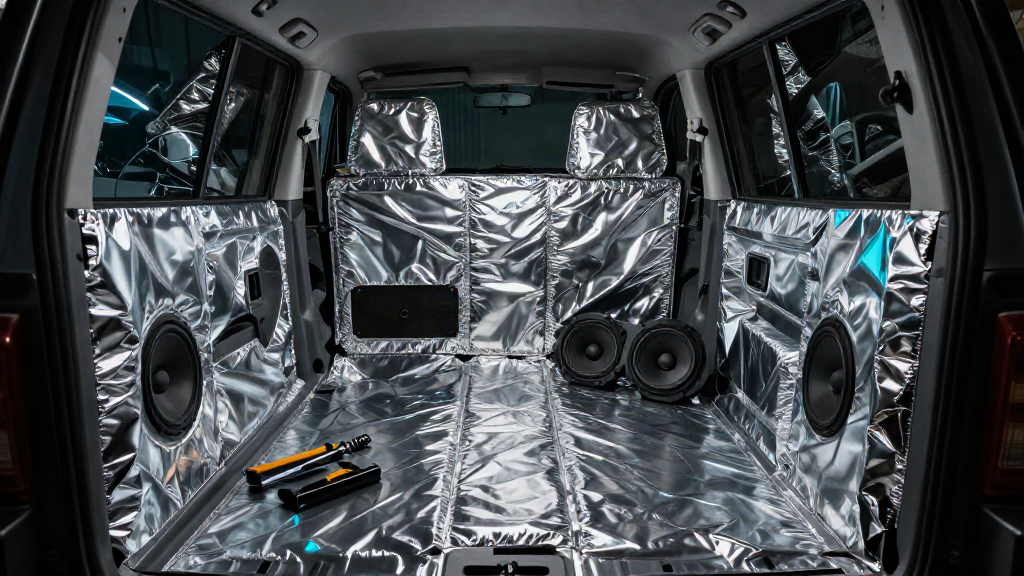
If you drive a 4WD, ute or family SUV around Brisbane, you already know the sound of a highway trip: the roar of all-terrain tyres, the drone of coarse bitumen, and the rattle of panels working over every bump. You turn the stereo up to cover it, and somehow the music still sounds flat and muddy. The good news is that this is a solved problem. Car sound deadening in Brisbane is one of the most cost-effective upgrades you can make to your vehicle, and it does two jobs at once – it makes your cabin quieter and it lets your speakers finally perform the way they were built to.
This guide walks you through how road noise enters your cabin, which sound deadening materials suit a 4WD or family SUV, and how a professional install transforms both comfort and car audio sound quality.
Why road and tyre noise ruins your car audio
Noise and music compete for the same space. When your cabin sits at a high background noise level, your ears have to work harder to separate the two, so you instinctively reach for the volume dial. That extra volume distorts the music, stresses your speakers and amplifiers, and leaves you fatigued at the end of a long drive.
There is also a physical problem. Most factory door skins and floor pans are thin stamped steel that flex and resonate. When a speaker is mounted into a flimsy, vibrating panel, it loses energy to that panel instead of pushing clean sound into the cabin. The result is thinner bass, smeared midrange and a soundstage that never quite locks in.
Sound deadening addresses both issues at the source. By adding mass and damping to the panels, you reduce the noise that reaches your ears and you give your speakers a rigid, solid baffle to work against.
Where noise gets into your cabin
A vehicle is not sealed against sound, and a 4WD or boxy SUV has more exposed metal and hard surfaces than a sedan. The main entry points we treat are:
-
Doors: the outer skin and inner frame radiate tyre and wind noise, and they are also where your speakers live.
-
Floor pan and firewall: the biggest path for road roar and engine drone, especially on coarse highway surfaces.
-
Rear wheel arches and cargo area: a large, hollow cavity on wagons and utes that acts like a drum and echoes noise forward.
-
Roof and rear doors: common culprits for heat and noise in family SUVs and people movers.
Because each of these areas behaves differently, a blanket approach wastes material. A good job targets the panels that actually make the noise.
Which sound deadening materials suit a 4WD, ute or family SUV
Not every product is right for every surface, and Brisbane’s climate matters. Under a hot Queensland sun a cabin can reach punishing temperatures, so the materials you choose need to stay stuck and stable rather than sagging off the door skin.
There are three broad categories worth understanding:
-
Constraint-layer damping: a butyl-rubber sheet with a foil facing that is applied directly to metal panels to add mass and stop resonance. This is the workhorse for doors, floor pans and wheel arches.
-
Acoustic absorption: open-cell foam or closed-cell insulation that soaks up airborne noise once it is inside the cabin, ideal for roof linings, cavity fills and behind trim.
-
Decoupling and barrier layers: dense mass-loaded vinyl or foam barriers that block noise from travelling through the body structure.
For a 4WD or ute that sees gravel, corrugations and highway touring, we usually combine damping on the metal with absorption in the cavities. This gives you the best of both – less resonance from the panels and less airborne noise reaching your ears. The products and thickness vary with your vehicle, your budget and how much of the interior you want to strip, which is why the plan starts with a proper look at your vehicle rather than a one-size-fits-all kit.
How professional installation improves comfort and speaker performance
Sound deadening is simple in principle and demanding in practice. Panels need to be clean, the material needs to be rolled down properly, and trim needs to go back exactly as it came out – without creaks, rattles or broken clips. That is where a technician who knows your vehicle makes the difference.
When we deaden a set of doors correctly, three things happen at once. The road and tyre drone drops away, your doors close with a solid, premium thud, and your speakers suddenly have a rigid enclosure to work in. Bass tightens up, vocals sit clearer in the mix, and you can hear detail in your music at a volume that is kinder to your ears and your equipment.
For a family SUV, the everyday wins are just as obvious: kids can hear their own conversations, phone calls through the hands-free are clearer, and long drives to the Sunshine Coast or down to the Gold Coast are far less tiring.
A practical, step-by-step approach
Here is how a typical sound deadening project unfolds with Celtic Car Sound:
-
Assess. We identify the dominant noise paths for your specific vehicle, driving style and tyres, so the material budget goes where it counts.
-
Plan. You get a clear, no obligation quote covering the areas, materials and labour – no surprises.
-
Treat. We strip the relevant trim, apply damping to the key metal panels, add absorption where airborne noise enters, and reassemble everything to factory-quality fit.
-
Verify. Doors and trim go back with no rattles, and we test the result with your sound system to confirm the improvement in both quiet and clarity.
Because we are a mobile service, much of this work can be handled at your home or office across Brisbane – convenient if you rely on your vehicle through the week and would rather not lose a day to a workshop.
Is sound deadening worth it for your 4WD?
If you own a 4WD, ute, van or family SUV and you regularly drive Queensland’s highways, the honest answer is usually yes. Sound deadening is one of those upgrades you notice on every single trip – quieter conversations, calmer music, less fatigue and a cabin that finally feels a class above.
It is also the smart companion to any car audio upgrade. There is little point investing in premium head units, amplifiers and speakers from names like Kenwood, Pioneer or Alpine if the cabin is drowning them out. Treat the vehicle first and every component you add afterwards performs better.
No responses yet