
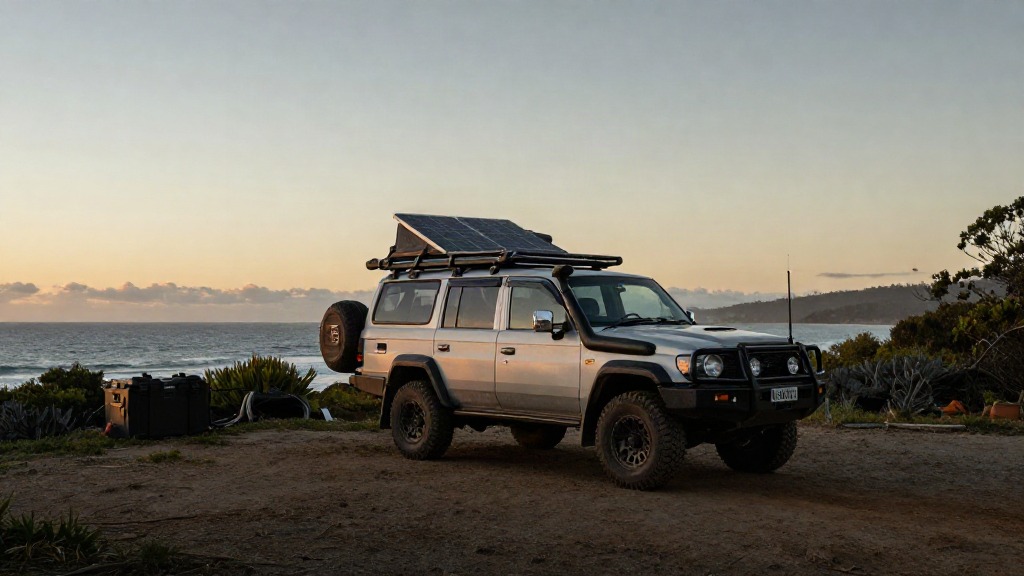
If you are planning your first big touring trip and the words ‘dual battery’, ‘DC-DC charger’ and ‘amp hours’ are already making your head spin, you are in good company. Most 4WD owners come to a 12v solar setup for 4WD touring the same way – knowing they want reliable power in the bush, but not quite knowing what goes into the box. This beginner’s guide walks you through the parts, the sizing, and the one decision that protects the whole investment.
What a 12v solar setup actually does for your 4WD
Think of your 12v solar setup as a small, self-contained power station built into your vehicle. Your start battery stays untouched and ready to turn the engine over, while a second battery quietly runs everything else: your fridge, lights, phone chargers, a compressor, a coffee machine, or a laptop for the kids in the back seat.
The point of adding solar is simple. Wherever the sun is out, your panels top the system back up without you idling the engine or hunting for a powered campsite. Spend a week at a beach camp near Bribie or a long weekend out past Esk, and a well-set-up 12v system for your 4WD keeps your fridge cold and your devices charged the whole time.
The core parts of a beginner setup
Every reliable 12v solar setup for 4WD touring comes down to four main pieces working together.
The auxiliary battery is your power store. A deep-cycle battery (AGM, gel or lithium) is designed to be drawn down and recharged repeatedly, which a normal start battery is not. This is the heart of the system.
The solar panel is your fuel supply. A fixed panel on the roof rack, a folding portable panel you set on the ground, or a mix of both all work – what matters is that the panel’s output matches how much power you actually use.
The DC-DC charger is the smart middleman. It takes power from your alternator while you drive and from your solar panel when you are parked, then feeds the auxiliary battery at the correct voltage. Without one, many modern vehicles simply never fully charge a second battery, and that is the most common mistake we see.
The wiring and fusing is the part nobody photographs but everybody depends on. Correct cable gauge, proper fuses and tidy terminations are what keep a system safe and reliable for years, not just on the first trip.
Sizing your system for the way you tour
There is no single ‘right’ size – there is only the right size for you. A daily commuter who wants a fridge for weekend trips needs far less than a couple living out of their 4WD for months on end.
Start with an honest list of what you will run and for how long each day. A 12v fridge might draw around 1 to 1.5 amp hours per hour in warm weather, so running one across a full day already adds up. Lights, chargers, a water pump and a portable inverter each add their own load on top.
Once you know your daily consumption, you can size the battery to carry you through a day or two of cloudy weather, and size the solar panel to put that energy back during a typical sunny day. As a rough guide, travellers who mostly move every day can get away with a modest setup, while anyone staying put for a week should plan for more panel and battery headroom.
If this sounds like maths you would rather not do alone, that is exactly what a proper installation consult is for. We will look at your vehicle, your gear and your travel style, then recommend a setup that fits – not the biggest, not the cheapest, but the right one for your 4WD.
Why professional auto electrical installation protects your setup
A 12v solar setup is only as good as its installation. Cheap cable, a missed fuse, or a charger wired to the wrong point can leave you with a system that underperforms, overheats, or quietly damages your expensive battery and your vehicle’s electronics.
Proper auto electrical work means the correct gauge cable for the current and the run length, fuses and circuit protection on every circuit, a safe mounting method that survives corrugations, and a charger configured to suit your exact battery chemistry. It also means your factory wiring and warranty stay intact – something that matters on newer 4WDs packed with electronics.
Fitted professionally, your system charges properly every day, copes with heat and dust, and keeps working trip after trip. That is the difference between a setup you trust and one you are forever fiddling with.
Getting your setup fitted around Brisbane
Because we come to you, sorting your 12v power does not mean losing your vehicle for days. We carry out mobile installation at your home or workplace across Brisbane and the surrounding areas – from Chermside and Carseldine through to Wynnum, Springwood, Ipswich and out towards Caboolture – so you can get on with your day while we work.
We fit and wire leading brands you can trust, back our workmanship with a guarantee, and treat your vehicle with the care and courtesy you would expect. Whether you drive a family wagon, a dual-cab ute or a fully kitted touring rig, we will set it up to suit.
Your next step
Planning a 12v solar setup for your 4WD does not have to be complicated, and you do not have to get it perfect on the first guess. Tell us how you travel and what you want to run, and we will give you clear, plain-English advice and a no obligation quote.
Book your mobile install or ask us a question today, and hit the road knowing your power is sorted by a Brisbane team that does this every day.
No responses yet